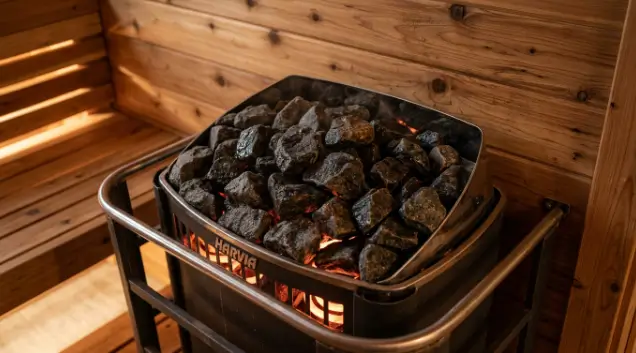
A small-space sauna heater needs a level, non-combustible base directly under and around it, whether that base is a poured concrete pad, a compacted gravel bed, or a wood deck fitted with a floor protector panel. The base does not have to cover the whole cabin footprint, but the clearance zone the manufacturer specifies around the heater itself has to be right. Get that wrong and you are either failing an inspection or, worse, running a heat source too close to something that can scorch.
Why does the base under a heater matter more than the base under the rest of the cabin?
A sauna cabin floor and the small footprint directly beneath the heater are not the same problem. Bench seating and walkway flooring just need to handle weight, moisture, and foot traffic. The zone under and around a 6 kW to 9 kW electric heater has to handle sustained radiant heat, occasional stone splash from water on the rocks, and in many installations a hard-wired electrical connection running to a junction box nearby. That is why most manufacturers spec clearance-to-combustibles distances specifically for the heater, separate from general flooring guidance for the rest of the room.
Is a concrete pad the safest choice for a small cabin?
Concrete is close to the default choice for a heater base because it does not shift, does not burn, and handles moisture from stone water without any prep beyond a basic seal. A 4-inch poured pad, or even a set of paver stones set in sand over a compacted sub-base, gives a permanently level surface that will not settle unevenly the way loose gravel can over a few seasons. For a small footprint, a partial pad just under the heater and its clearance zone is often enough, rather than pouring the whole cabin floor in concrete.
When does gravel make more sense than a hard pad?
Gravel drains better than almost anything else, which matters if the cabin sits somewhere that collects runoff or snowmelt. It is also cheaper and faster to put down than a poured pad. The tradeoff is that gravel needs a properly compacted sub-base before the top layer goes down, or it settles unevenly under the heater’s weight within a season or two, which can tilt the unit slightly and throw the stone bed and guard rail out of alignment. If you go this route for a small space, plan on at least 4 inches of compacted crushed stone under a finer top layer, with a paver or steel plate set at the exact heater footprint for a stable, level mounting point.
Can you mount a small heater on an existing wood deck?
Yes, but not directly against bare decking in most cases. A wood deck needs a non-combustible floor protector, commonly a mineral board or tile-over-cement-backer panel, placed under the heater and often extending up the nearest wall as well. The exact clearance distances and whether a protector is required at all depends on the specific heater model, so this is one detail worth confirming against the installation manual before you finalize a deck-mounted layout. Package heaters sold with full spec sheets make this comparison easier, and looking at SweatDecks’ lineup is a reasonable way to see clearance and base requirements laid out side by side for a 6 kW unit before you commit to a deck installation.
What actually goes wrong when the base is skipped or done wrong?
The most common problem is not a fire, it is a slow one: a heater that sits slightly out of level over an unstable base develops uneven stone loading, which changes how heat distributes through the cabin and can shorten heating element life. The second most common problem is a failed inspection when a protector panel was skipped under a heater mounted on wood decking, which means redoing finish work that was already installed around it. Both are avoidable by settling on the base material before the heater arrives, not after.
How do you choose between these three options for a small space?
For a permanent, all-season installation, a concrete pad or paver base under the heater’s footprint is the lowest-maintenance option and rarely needs revisiting. For a site with drainage concerns or a lower upfront budget, compacted gravel with a stable plate at the heater mount is a workable middle ground. For a cabin already built on an existing deck, a floor protector panel sized to the manufacturer’s clearance spec is usually the only path that does not involve tearing up finished decking. None of these choices are permanent regrets, since a heater base is a relatively small, contained project even if you change your mind after a season.
Does regular sauna use justify the extra base work?
A systematic review published in Evidence-Based Complementary and Alternative Medicine looked across multiple studies of regular dry sauna bathing and found associations with several cardiovascular and general health markers among consistent users, and a Mayo Clinic Proceedings review reached similar conclusions while noting the evidence is strongest for people who use a sauna several times a week rather than occasionally. These findings describe association, not proof that sauna sessions alone cause the benefit. Still, for anyone planning to use a small cabin heater regularly rather than a few times a year, spending a weekend getting the base right the first time avoids redoing it later.
Frequently Asked Questions
Can a sauna heater sit directly on a wood deck?
Only with the manufacturer’s specified clearance to combustibles and, in many cases, a non-combustible floor protector under and behind the unit. Most package heaters list a minimum clearance in inches from wood surfaces on all sides.
Is a concrete pad better than gravel under a small sauna?
Concrete gives a level, permanent base and handles the heater’s weight and vibration with no settling. Gravel is cheaper and drains well but needs a compacted sub-base and periodic releveling, which matters more for a heater than for open deck seating.
What is a floor protector pad and do I need one?
A floor protector is a non-combustible panel, often mineral board or tile over cement backer, placed under and sometimes behind a heater to meet clearance-to-combustibles rules. Most codes require one when the heater sits on or near wood flooring.
How much clearance does a sauna heater need from a wall?
Clearances vary by model but commonly range from 3 to 8 inches at the sides and back, with more space required at the front for stone loading and guard rail access. The exact figure is printed in the heater’s installation manual.
Does the base material affect how long a sauna heater lasts?
Indirectly, yes. A stable, level, non-shifting base keeps the heater’s electrical connections and stone bed sitting correctly over years of heat cycling. A base that settles or shifts can stress wiring at the junction box and throw stones out of alignment.
References
- Cardiovascular and Other Health Benefits of Sauna Bathing: A Review of the Evidence, Mayo Clinic Proceedings, 2018
- Clinical Effects of Regular Dry Sauna Bathing: A Systematic Review, Evidence-Based Complementary and Alternative Medicine, 2018
- Benefits and risks of sauna bathing, The American Journal of Medicine, 2001
- NFPA fire and clearance codes, National Fire Protection Association
By Marisol Vega